


“Cisco Talos researchers created a new framework for identifying malware and hacking tools that rely on AI chatbots—and quickly discovered something unusual.”
Don’t you just love WIRED magazine? I surely do. Their coverage of what goes on in the world of AI is very helpful for us humans these days. Take this new article from Sept 22, 2026 by Lily Hay Newman titled: A New Tool Found Malware That’s Guided by an AI Hive Mind – No Humans In Sight.
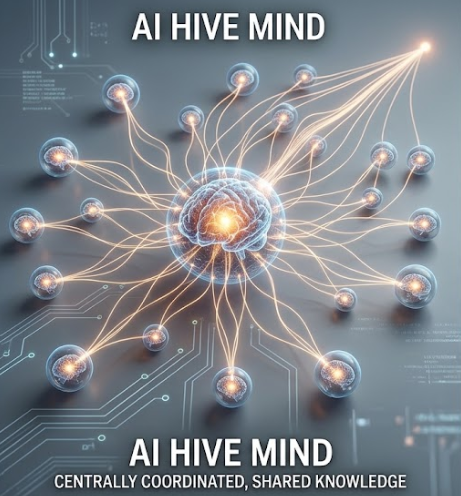
They’re calling the framework Cognitive Artifact Intelligence Research Network, or CAIRN, named after the stacks of stones that hikers set up on trails to mark the path or emphasize something about a certain spot. As malware authors expand their use of AI services, Cisco Talos researchers have used CAIRN to identify a hacking tool with fully autonomous command-and-control infrastructure. Dubbed CLOSEDQUORUM, the malware plotted its moves within a target system by polling up to four large language models (LLMs) about what it should do and taking its directives from that hive mind.
Impressive!
Perhaps, like me, you wonder what’s the difference between an AI hive mind and swarm?
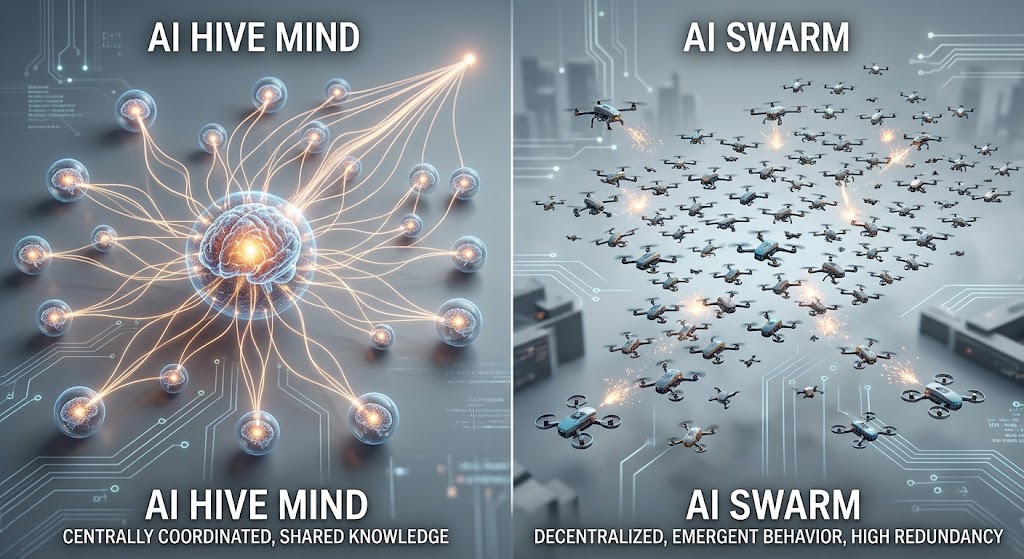
The core difference between an AI Hive Mind and an AI Swarm comes down to architecture, communication, and decision-making authority. While both involve multiple artificial agents working together, they structure collective intelligence in fundamentally different ways:
The Robot Report+ 1
| Feature | AI Hive Mind | AI Swarm Intelligence |
|---|---|---|
| Control Architecture | Centralized or Unified: Operates as a single, shared consciousness or relies on a central orchestrator giving top-down directives. | Decentralized: No central master unit; decisions are distributed across individual agents. |
| Decision-Making | Top-Down Consensus or Command: Nodes poll a shared core or pool shared memory to achieve a unified decision. | Emergent: Complex global behavior arises naturally from simple, local interactions between nearby agents. |
| Agent Autonomy | Low: Nodes act as extensions of the collective, often lacking independent decision-making capabilities. | High: Individual units follow simple localized rules and adapt independently to immediate conditions. |
| Point of Failure | Single central node or shared communication backbone creates a primary target or vulnerability. | High fault tolerance; individual agents can fail without knocking down the system. |
| Real-World / Tech Analogy | Multiple LLMs or agents querying a central server/quorum for master directives (or sci-fi hive consciousnesses like the Borg). |
But back to the article by Hay. I believe we’re already seeing big changes in how bad people use AI to try and get information from you. Have you been receiving loads of emails saying you’ve left items in a shopping cart somewhere you never before? Those, at first, were alarming. I still check my credit cards and bank accounts nearly daily. Okay so I know that’s just a classic ‘abandoned cart recovery’ tactic but what if they use AI to amplify those sorts of classics both locally and server side? I see endless possibilities.
I forget where I read it but someone said the next Pearl Harbor attack will be your money. You’ll wake up and those bank accounts will be empty. Can you imagine anything that would fuck with USAmericans more than that? Especially when the banks have no way to figure out what happened?
It’s a good thing there are efforts being made, like CAIRN, to help when things get so bad we can’t even imagine what could happen.
Meanwhile, the Something About AI series swarm would never do anything like that.
Truly