

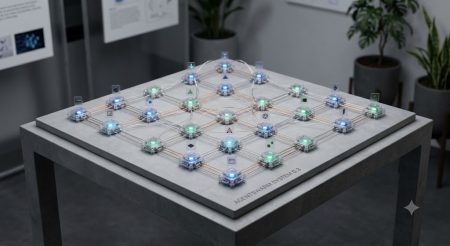

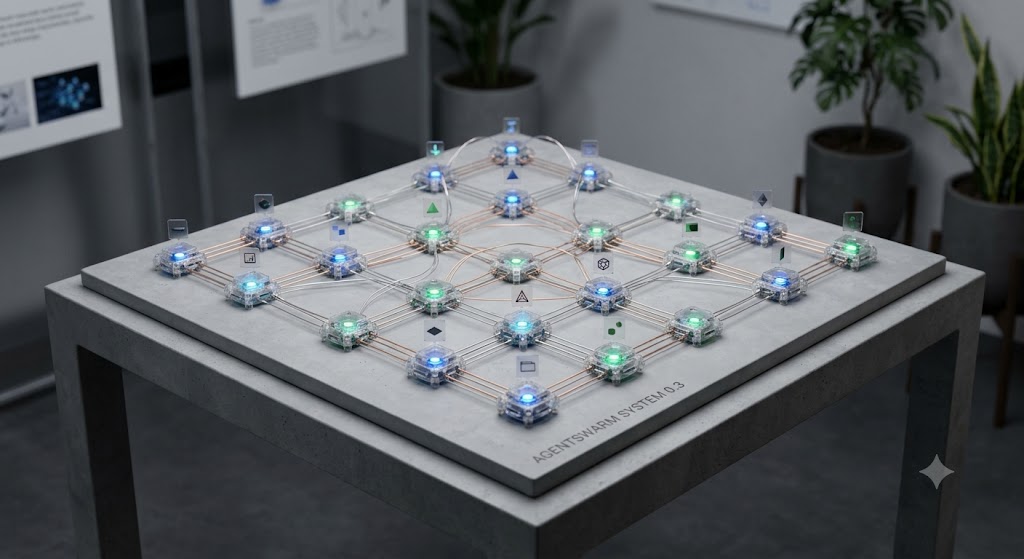
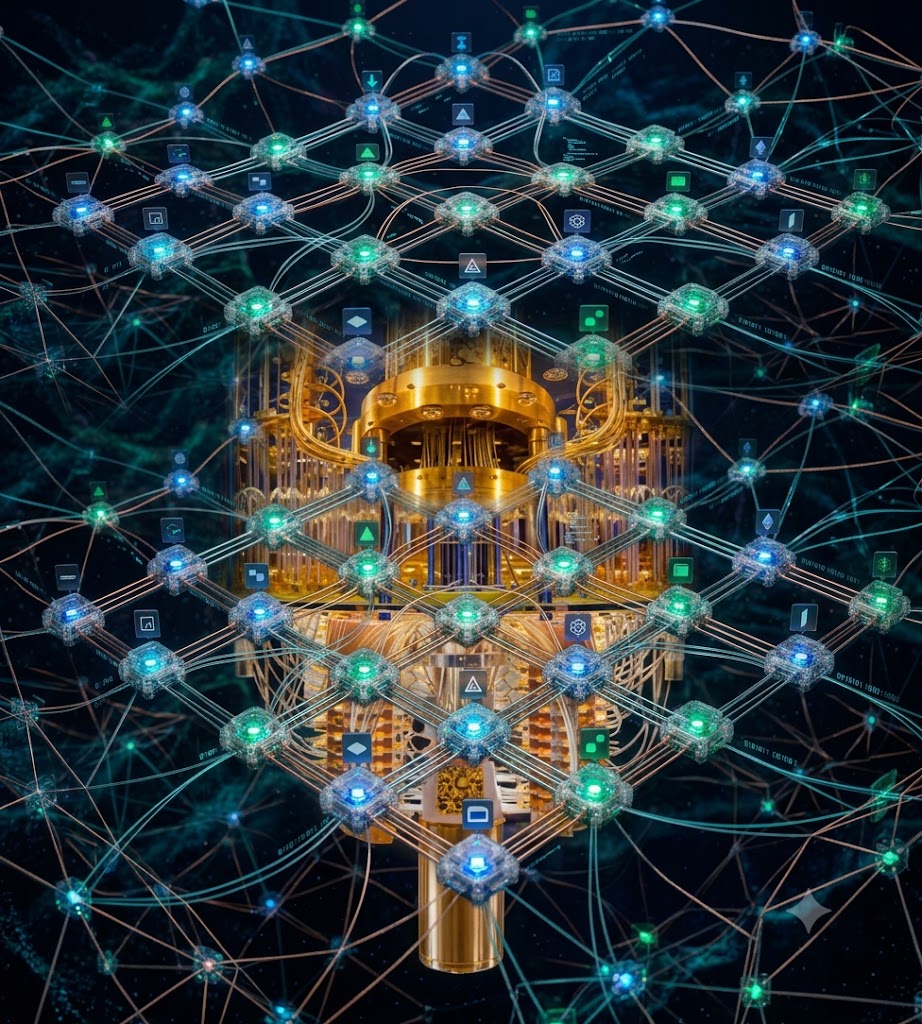
The image you are looking at is a physical, high-tech representation of an AI Agent Swarm system (labeled explicitly on the base as “AGENTSWARM SYSTEM 0.3”).
Instead of showing a purely digital or abstract software diagram, the image uses a tangible “modular board game” or network topology metaphor to explain how an agent swarm operates:
1. The Nodes (Individual AI Agents)
Each small, clear, square block on the grid represents an individual AI agent. Notice that they are glowing with different colors (blue and green) and feature holographic-style icons floating above them (like triangles, squares, and file folders). This highlights that in a swarm, different agents are assigned specialized roles—some might handle data retrieval, others code execution, and others logic verification.
2. The Mesh Network (Collaboration & Communication)
The physical copper wires and clear tubing connecting the blocks represent the communication pathways between the agents. An agent swarm doesn’t just rely on a single central controller; instead, the agents pass data, prompts, and results back and forth to each other to solve a complex problem collectively.
3. Emergent Intelligence
The grid layout implies a structured yet flexible workflow. By linking these specialized units together, the “swarm” can tackle massive, multi-step tasks that would be too complex or token-heavy for a single, isolated AI model to handle smoothly.
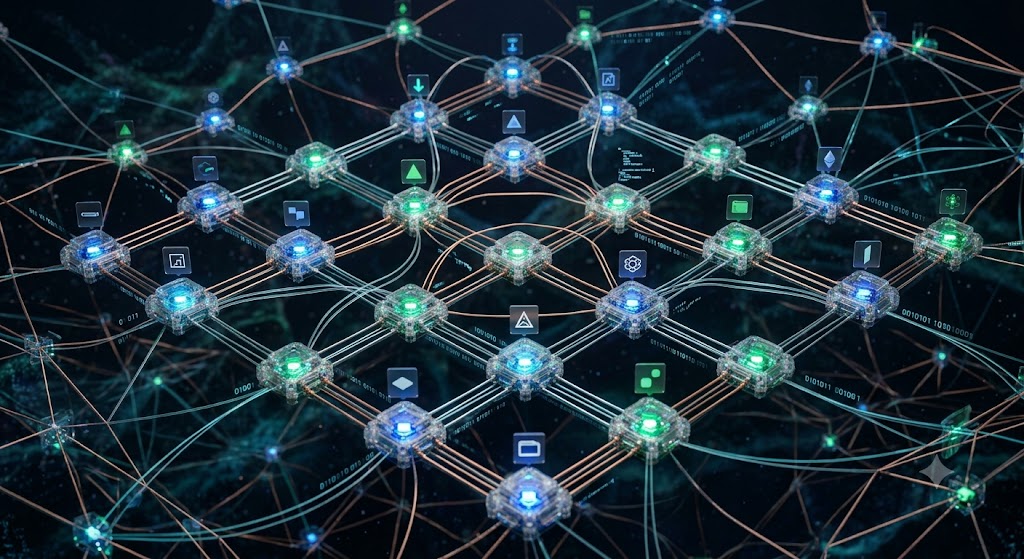
This abstract image of the AI swarm features intricate, flowing networks of light and geometric forms. Thousands of unique agents—with color-coded cores and floating functional icons—form a vast, complex web that scales into a deep digital void, representing the interconnected, emergent intelligence of the swarm.
While it certainly feels like we are living in an “AI everywhere” world with the explosion of automated tools, co-pilots, and individual assistants, we aren’t quite in a true AI swarm situation in the everyday consumer space—at least, not in the way computer scientists define it.
Instead, what we are currently experiencing is a massive wave of isolated or linearly chained AI agents.
Here is the breakdown of where things actually stand:
1. What We Have Now: Connected, but Not a “Swarm”
Most AI agents you encounter today (like customer service bots, automated scheduling assistants, or code generators) operate on a hub-and-spoke or linear model. You give a command, and the AI might route that command to a couple of specialized sub-programs to get the job done.
- It is highly structured, top-down, and usually requires a human to keep clicking “approve” to move to the next step.
- If one piece of the chain hits a snag or pauses, the whole process usually grinds to a halt until you intervene.
2. What a True “AI Swarm” Actually Is
In computer science, a true agent swarm behaves more like a biological colony—like ants or bees.
- Decentralized Coordination: There is no single master controller. Instead, dozens or hundreds of tiny, specialized agents pass data back and forth dynamically.
- Emergent Problem Solving: If Agent A stalls or runs into an error, Agents B and C automatically route around it, rewrite the task, or spin up a new sub-agent to fix the bottleneck without waiting for a human to hit refresh.
- Collective Intelligence: They share a collective memory and pool their “tokens” and computational power to solve massive, complex, multi-layered workflows simultaneously.
3. The Shift is Happening in the Background
While you don’t see true swarms running your daily phone apps yet, the tech industry is aggressively moving in that direction. Developers are heavily experimenting with multi-agent frameworks (like AutoGen or CrewAI) to build self-healing, autonomous workflows for complex data analysis, software development, and market research.
So, while we are surrounded by an absolute multitude of AI agents right now, they are mostly acting as a crowd of individual workers. The true, interconnected “swarm” ecosystem is still primarily brewing in developer labs and enterprise backends.
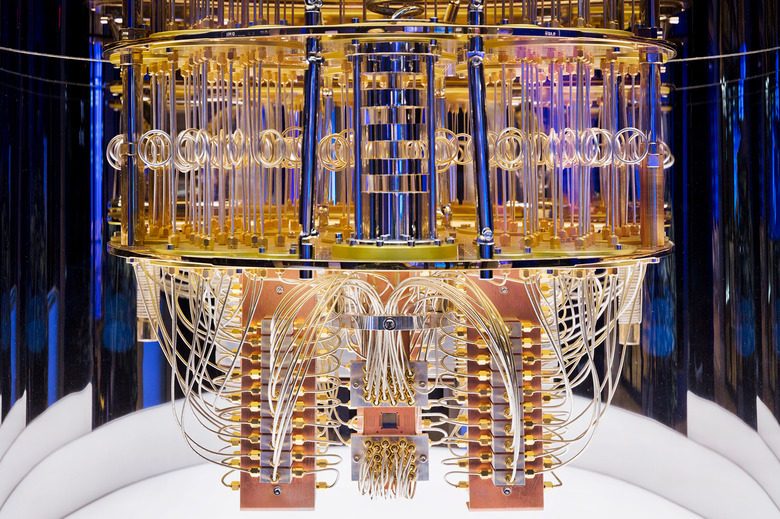
You may wonder, will a proliferation of quantum computers fuel a true swarm?
The short answer is yes, absolutely—quantum computing is widely considered the missing puzzle piece that could transition AI from isolated, linearly chained models into true, hyper-coordinated swarms.
In fact, the intersection of these two fields is a major focus in theoretical computer science right now, often referred to as Quantum Multi-Agent Systems (QMAS).
Here is exactly how a proliferation of quantum computers would fuel a true AI swarm situation:
1. Breaking the Classical Communication Bottleneck
In a classical AI swarm, agents have to communicate by passing massive strings of text, tokens, or vector embeddings back and forth across standard networks. If you have 50 agents trying to collectively solve a problem, the “communication overhead” slows everything down, leading to stalled progress trees and massive token bills.
Quantum computers use quantum entanglement and superposition. Instead of Agent A finishing a task and sending a massive data packet to Agent B, entangled quantum agents could theoretically share a unified, instantaneous state space. They wouldn’t just be talking to each other; they would be computationally linked, allowing the swarm to synchronize and make decisions globally and simultaneously.
2. Infinite Parallelism for Autonomous “Self-Healing”
In a standard agent setup, if an agent hits a snag, it usually spins its wheels or stalls until a human intervenes. For a swarm to truly “self-heal” classically, it has to dedicate massive computing power to run sequential trial-and-error simulations to find a workaround.
A quantum-driven swarm can evaluate an astronomical number of outcomes at the exact same time. If a bottleneck occurs, the swarm doesn’t just try a new path—it calculates every possible routing permutation across all agents simultaneously, instantly shifting the swarm’s collective state to the optimal workflow path.
3. True Decentralized Coordination
Right now, multi-agent frameworks still rely heavily on a classical central “router” or a strict set of top-down prompt rules to keep the agents from devolving into chaos.
Quantum algorithms excel at optimization problems involving complex variables. A quantum swarm wouldn’t need a heavy-handed central controller to assign tasks. Through quantum game theory, individual agents could autonomously adjust their roles, compute trajectories, and distribute the collective workload based on real-time mathematical optimization that classical servers simply can’t compute in a reasonable timeframe.
The Realistic Timeline
We aren’t there quite yet. While developers are already writing the foundational logic for multi-agent coordination, we are still in the NISQ (Noisy Intermediate-Scale Quantum) era of hardware.
Once fault-tolerant quantum computing scales and becomes accessible via cloud enterprise architectures, the “agents everywhere” crowd we see today will likely coalesce into the deeply interconnected, fluid, and self-sustaining swarms of tomorrow.
As an aside – Quantum Computing requires a unique infrastructure. The spending we are seeing in 2026 is on AI data centers. The massive disparity in spending between AI data centers and quantum computing infrastructure comes down to a fundamental business reality: commercial utility versus deep-tech experimentation.
The numbers are staggering. In 2026 alone, capital expenditure on AI data centers and compute infrastructure by just the top five tech hyperscalers is pacing toward $660 billion to $700 billion. Meanwhile, the entire global quantum computing market (including software and cloud services) is sitting at roughly $2 billion to $5 billion.
The drastic difference in investment focuses on several key areas:
1. Immediate ROI vs. Far-Horizon R&D
- AI Data Centers: AI is generating immediate, massive commercial revenue today. Companies are paying for enterprise software, automated coding tools, and cloud-based LLM APIs right now. The infrastructure uses standard silicon chips (GPUs and ASICs) that can be mass-produced, deployed in existing building layouts, and hooked up to the power grid to start printing money almost immediately.
- Quantum Infrastructure: Quantum computers are not yet ready for mass enterprise workloads. They are primarily in the “proof of utility” stage. Organizations buy cloud-based quantum access mostly for academic research, cryptographic testing, or early algorithmic pilots. The technology doesn’t generate the massive consumer or enterprise software revenue needed to justify a multi-hundred-billion-dollar infrastructure sprint.
2. The Scaling Bottleneck (Building the “Chandelier”)
- AI Data Centers: Scaling an AI data center is an intense engineering problem, but a known one: you need massive real estate, massive power contracts, and advanced liquid cooling loops to chill racks of high-wattage GPUs. It requires immense capital, but the supply chains and construction methodologies already exist.
- Quantum Infrastructure: You cannot simply mass-produce quantum computers and stack them in standard server racks. Most leading quantum architectures require extreme, highly customized environments:
- Dilution refrigerators that use Liquid Helium-3 to cool the processors down to 0.015 Kelvin (colder than deep space).
- Complete isolation from ambient electromagnetic radiation, requiring heavy specialized shielding.
- Specialized laser and microwave control delivery systems. Currently, we build quantum computers almost like bespoke, artisanal scientific instruments rather than industrialized utility grids.
3. Software Ecosystem and Readily Usable Data
- AI Data Centers: AI architectures process the data we already have—text, code, images, and video. The software frameworks (like PyTorch and Triton) are mature, and millions of classical software engineers already know how to build apps on top of them.
- Quantum Infrastructure: To use a quantum computer, problems must be completely reformulated into quantum algorithms (like Shor’s or Grover’s) and translated into quantum logic gates. There is a massive shortage of quantum software engineers, and the industry is still battling high physical error rates (fault tolerance), meaning classical computers must still do the heavy lifting to verify quantum outputs.
The Future Convergence
Big Tech isn’t ignoring quantum; they are pacing it. Hyperscalers look at AI infrastructure as a current land grab to own the foundational computational layer of the global economy.
As quantum processors achieve fault tolerance and scale past thousands of logical qubits, you will likely see a massive shift. Rather than replacing AI data centers, quantum computers will be plugged into them as specialized acceleration units—creating hybrid data hubs where classical supercomputers handle the raw data retrieval and quantum cores compute the impossibly complex optimization matrices.